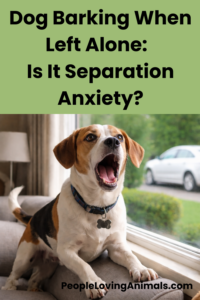
You leave the house, and within minutes your dog is barking. Maybe your neighbor has mentioned it. Maybe you’ve heard it yourself through the door. Either way, you’re wondering — why does my dog bark when left alone, and how can I stop it?
The reason your dog is barking matters, because the solution depends entirely on the cause. In this post, you’ll learn the real reasons dogs bark when left alone, how to tell the difference between separation anxiety and a learned barking habit, and the most effective ways to stop the dog from barking when you leave.
👉 Go straight to the solution: Get “Excessive Barking Be Gone”
Affiliate disclosure: This post contains affiliate links. If you make a purchase, I will earn a commission at no extra cost to you. I donate 10% of my profits to animal charities.
What Causes a Dog to Bark When Left Alone?
There are two main reasons a dog barks when left alone: separation anxiety and learned barking behavior. While both can sound identical from the outside, they have very different causes — and require different solutions. Understanding which one your dog is experiencing is the first step to solving the problem.
Separation anxiety is rooted in genuine distress. Your dog isn’t misbehaving — he’s panicking. Dogs with separation anxiety see their owner as their entire source of safety and security. When you leave, they experience real fear. Barking is just one symptom. You may also notice destructive behavior, pacing, drooling, accidents in the house, or attempts to escape.
Dog separation anxiety truly breaks my heart. How scary it must be for the dog to be home alone when they don’t feel safe!
Learned barking behavior is different. Some dogs bark when left alone simply because it has worked before — someone came back, a neighbor reacted, or the behavior was never properly addressed. This type of barking is less about distress and more about learned behavior.
And there are causes for that too. If your dog has developed a habit of barking when you leave, there’s a reason. And you won’t get it solved until you figure out what’s actually causing it.
How to tell the difference:
- Does your dog show signs of panic before you even leave — following you room to room, trembling, or refusing to settle? That points to separation anxiety. I had a Dachshund once who would sit on my feet if I put my sneakers on!
- Does your dog seem fine until you actually walk out the door, then bark for a while before stopping? That may be a habit or boredom rather than true anxiety.
- Does your dog destroy things, have accidents, or injure himself trying to escape? That strongly suggests separation anxiety.
Understanding which problem you’re dealing with is the first step toward solving it.
Why Dog Separation Anxiety Happens
According to Professional Dog Trainer, Doggy Dan, separation anxiety often develops when a dog feels responsible for being “in charge” rather than trusting that their owner is the leader of the pack. If your dog does not fully see you as the decision-maker, they may believe it’s their job to protect you and the home.
When you leave, this can create stress and fear because your dog suddenly feels alone with a responsibility they don’t feel confident handling. From their point of view, they are not being stubborn or disobedient — they are anxious because they think they must stay alert, guard the environment, and keep everything safe until you return.
Not to mention they may feel responsible for your safety as well, so you being out in the world alone is stressful for them.
This is why punishment when you get home never works. Your dog was not trying to misbehave. He was reacting to anxiety and uncertainty.
Changes in routine, moving to a new home, adding a new family member, or inconsistent leadership can all increase this sense of responsibility. Dogs who have never been taught to relax, settle, and trust that you are in control are much more likely to struggle when left alone.
According to the ASPCA, separation anxiety in dogs is characterized by extreme distress when left alone — and is one of the most common behavioral issues dog owners face.
To learn more about dog separation anxiety, check out my post, Treating Dog Separation Anxiety – Tips to Help Your Dog Stay Home Alone (includes video) and Signs Your Pet May Have Separation Anxiety.
What Is Learned Barking Behavior?
Not all dogs who bark when left alone are experiencing separation anxiety. Some dogs bark simply because the behavior has been reinforced over time — even unintentionally. If barking brought you back, prompted a neighbor’s reaction, or was never consistently addressed, your dog may have learned that barking gets results. This type of barking is not rooted in fear or panic, but it still needs to be addressed with consistent, proper training.
To learn more about what causes dog barking and tips to help control it, check out my post, Ways to Stop Dog Barking (includes video).
How to Stop Dog Barking When Left Alone
Whether your dog is dealing with true separation anxiety or a learned barking habit, the solution starts in the same place — establishing calm, confident leadership so your dog feels safe whether you’re home or not.
World-renowned dog trainer and behavioral specialist, Doggy Dan, has developed two programs specifically designed to address these issues.
👉 Go straight to the solution for barking: Get “Excessive Barking Be Gone”
For excessive barking of any kind:
Doggy Dan’s Excessive Barking Be Gone program covers every barking scenario including barking when left alone, barking at the door, barking in the car, and barking for attention. Proven by over 80,000 dog owners, this step-by-step video course gives you the exact tools to quiet your dog quickly.
You can visit the program directly here, or read my full review here.
For separation anxiety specifically:
If your dog’s barking is rooted in genuine distress, Doggy Dan’s separation anxiety program addresses the root cause — helping your dog feel safe and secure even when you’re not home.
You can visit the Stop Separation Anxiety program here.
3 Common Mistakes That Make Dog Barking When Left Alone Worse
If your dog barks when left alone, some of the most well-meaning responses can actually reinforce the problem. Here are the mistakes dog owners most commonly make — and why they backfire.
1. Don’t make a big fuss when you leave or return. Emotional goodbyes and excited hellos reinforce your dog’s belief that your departure is a big deal. Keep it calm and matter-of-fact.
2. Don’t punish barking after the fact. Your dog won’t connect the punishment to the barking. It only creates more anxiety.
3. Don’t rely on leaving the TV on or giving treats at the door. These are band-aids, not solutions.

The Bottom Line About Dogs Barking When Left Alone
A dog who barks when left alone is telling you something — either that he’s genuinely distressed, or that a bad habit has gone unaddressed. Either way, the good news is that both problems are very fixable with the right approach.
The key is understanding what’s driving the behavior and addressing it at the root. Whether you need the barking program, the separation anxiety program, or both, Doggy Dan’s training has helped tens of thousands of dog owners find lasting peace and quiet.
I’ve been recommending Doggy Dan’s dog and puppy training programs on this website for more than 10 years. That’s because I agree with his kind dog training methods, and because his techniques are easy to apply and extremely effective.
Your dog wants to feel calm. With the right guidance, he can get there — and so can you. I hope you found this post helpful, and enjoy the peace and quiet! Debra
More Help to Stop Dog and Puppy Barking
- Dog Barking When Left Alone: Is It Separation Anxiety?
- Ways to Stop Dog Barking
- How to Stop Puppy Barking
- Dog Barking Driving You Crazy?
For More Help with Dog Training, Click Here
💬 Did this help you? If you have a question, helpful tips, or even a struggle related to this topic, please leave a comment below — it helps other readers more than you know.
Pin it for Later!