
Training your own service dog is legal in the United States under the Americans with Disabilities Act (ADA), but it is often misunderstood. Many people assume service dogs must come from expensive organizations, must be professionally trained, or must carry special registration or certification. None of that is required under federal law.
This guide explains what the law actually says, what service dogs are (and are not), what realistic owner-training looks like, and what truly matters if you are considering training your own service dog.
👉 If you’re planning to train your own service dog, I recommend this online program for dog owners: Service Dog Training School
This post contains affiliate links. If you make a purchase, I’ll earn a commission (at no extra cost to you). I donate 10% of my profits to animal charities.
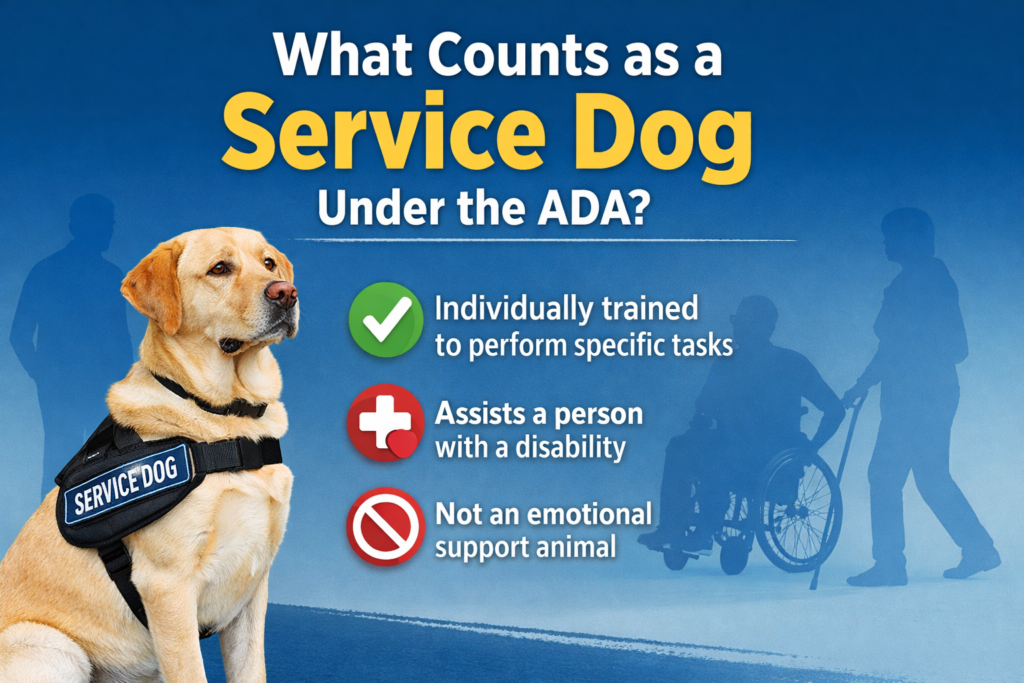
What Counts as a Service Dog Under the ADA?
Under the Americans with Disabilities Act (ADA), a service dog is a dog that has been individually trained to perform specific tasks or work that directly help manage a person’s disability.
The disability may be physical, psychiatric, sensory, intellectual, or another qualifying condition. What matters is that the dog is trained to perform specific tasks that help the handler function more safely or independently.
Examples of Legitimate Service Dog Tasks
Service dog tasks vary depending on the owner’s needs. Common examples include guiding a visually impaired owner, alerting to medical changes such as blood sugar drops or seizures, interrupting panic attacks, retrieving dropped items, providing balance support, or creating space in public environments.
The key factor is that the dog performs trained tasks. Comfort alone does not qualify. If the dog is merely providing comfort, that would fall under Emotional Support Animals or Therapy Dogs.
Service Dogs vs Emotional Support Animals vs Therapy Dogs
These terms are often used interchangeably, but they are not the same legally. Let’s discuss the differences among these titles:
What Is a Service Dog?
A service dog is a dog that has been individually trained to perform specific tasks that assist a person with a disability. Under the Americans with Disabilities Act (ADA), service dogs are permitted in public places where pets are normally not allowed, as long as the dog is under control and trained to perform disability-related work.
What Is an Emotional Support Animal (ESA)?
An emotional support animal (ESA) is an animal that provides comfort or emotional support through its presence, rather than through trained tasks.
Emotional support animals do not have public access rights under the Americans with Disabilities Act (ADA), but they may have certain housing protections under the Fair Housing Act, which are separate from service dog laws.
You can learn more about making your pet an Emotional Support Animal at CertaPet.
What Is a Therapy Dog?
A therapy dog is a dog that is trained to provide comfort or support to people other than its owner, often in settings such as hospitals, schools, or nursing homes. Therapy dogs do not have public access rights and are not considered service dogs under the Americans with Disabilities Act (ADA).
For more details, check out this post from Professional Dog Trainer, Doggy Dan, The Difference Between Service Dogs and ESA’s.

Can a Cat Be a Service Animal?
No. Under the Americans with Disabilities Act (ADA), only dogs are recognized as service animals. In limited circumstances, miniature horses may also qualify, but cats are not considered service animals under federal law.
Even if a cat is highly trained or provides meaningful assistance, it does not have public access rights as a service animal. This means cats are not legally permitted in public places where pets are normally prohibited.
Cats can, however, qualify as emotional support animals (ESAs). Emotional support animals may have housing protections under the Fair Housing Act, but they do not have public access rights and are not service animals.
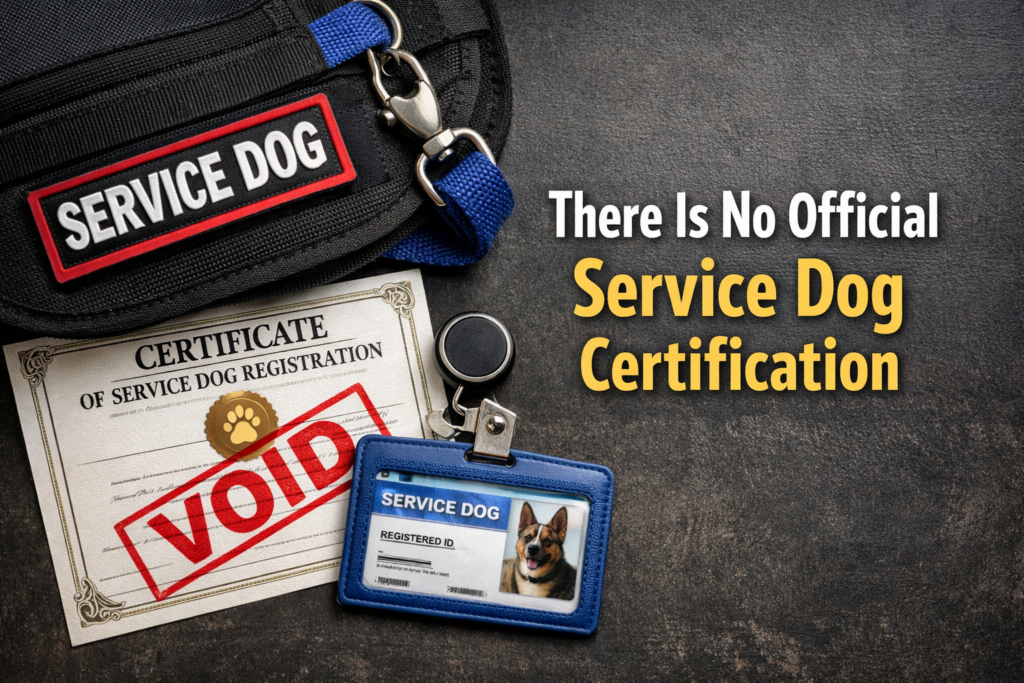
There Is No Official Service Dog Certification
This point is critical.
In the United States, there is no government registry, ID card, certificate, or official licensing process for service dogs. Websites that sell service dog registrations or certifications are not issuing anything legally required or recognized.
Online training programs do not certify service dogs. They provide education, structure, and guidance for owners who are training their own dogs. Whether a dog qualifies as a service dog depends on behavior, task training, and legal compliance, not paperwork.
Is It Legal to Train Your Own Service Dog?
Yes. The ADA explicitly allows individuals with disabilities to train their own service dogs. You are not required to use a professional trainer or organization.
However, legal does not mean easy.
Owner-trained service dogs must meet the same behavioral and training standards as professionally trained dogs when working in public. Check out my post, Training Your Own Service Dog: 5 Common Mistakes.
👉 If you’re considering training your dog as a service dog, I recommend this online program for dog owners: Service Dog Training School
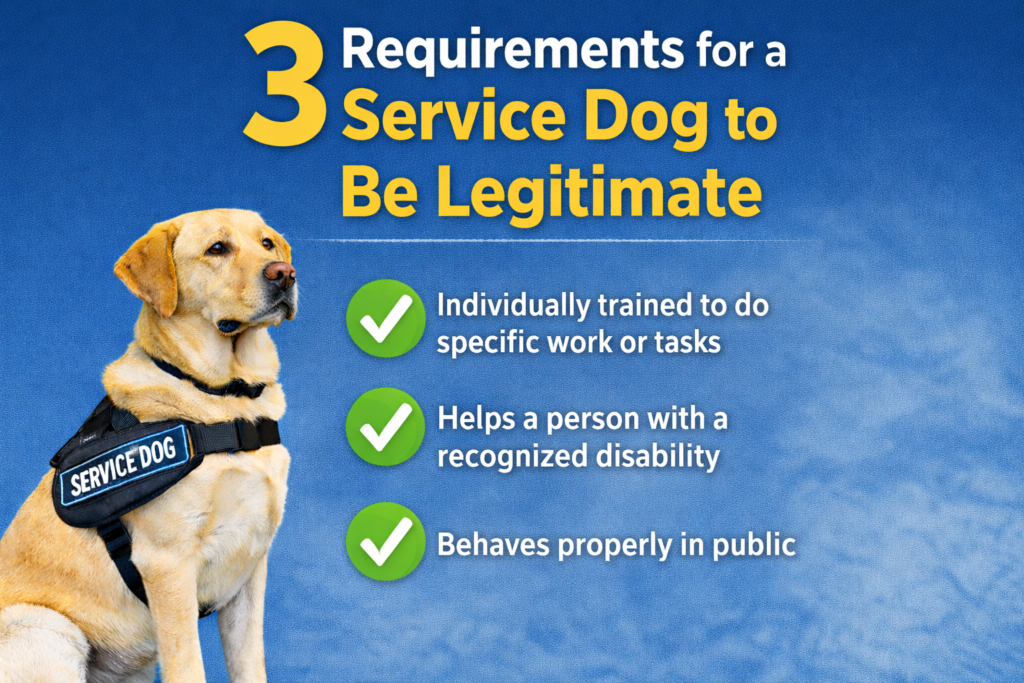
What Actually Makes a Service Dog Legitimate?
A legitimate service dog must meet three practical standards:
1. The Dog is Trained to Perform Disability-Related Tasks
The tasks must be trained behaviors that directly help with the owner’s disability. Emotional comfort alone is not enough.
2. The Dog Is Under Control in Public
The dog must be housebroken, non-aggressive, and able to behave appropriately in public spaces. Excessive barking, lunging, or other disruptive behavior can result in a service dog being excluded from a public place if the owner does not bring the dog under control.
3. The Owner Can Answer These Two Legal Questions
Businesses are allowed to ask only two questions under the ADA:
-
- Is the dog required because of a disability?
- What work or task has the dog been trained to perform?
You are not required to disclose your diagnosis or provide documentation.
Realistic Expectations for Training Your Own Service Dog
Training a service dog is a process that requires time, consistency, and clear expectations. Most owner-trained service dogs are trained over time through consistent practice, real-world exposure, and clear expectations.
Progress looks different for every dog and owner. Some skills come quickly, while others require patience and repetition. What matters most is having a structured approach, realistic goals, and an understanding of how service dog training actually works in everyday life.
Not every dog is suited for service work, and reassessing a dog’s role along the way is part of responsible training. With the right guidance, many dog owners are able to build strong, reliable skills and determine whether their dog is a good fit for service work.
👉 If you’ve decided to train your dog to be a service dog, I recommended this online program for dog owners: Service Dog Training School
Common Reasons Why a Dog May Not Make a Good Service Dog
Not every dog is suited for service work, even with good training. Some dogs struggle with anxiety, reactivity, health limitations, or the demands of busy public environments. In these cases, the issue is usually the dog’s comfort or suitability for the role—not a failure on the part of the owner or trainer.
Responsible service dog training includes recognizing when a dog is not a good match for service work and making adjustments that prioritize the dog’s well-being and the owner’s needs and safety.

Do Online Service Dog Training Programs Work?
Online service dog training programs can be helpful for dog owners who want structured guidance while training their own service dog. These programs are designed to teach training principles, explain how service dog tasks are developed, and outline what appropriate public behavior looks like under the law.
Rather than replacing hands-on practice, online programs provide education, step-by-step instruction, and clarity around expectations. Many dog owners use them to better understand how to train responsibly, avoid common mistakes, and build skills progressively at home and in real-world settings.
One example of an educational program designed specifically for owner-trained service dogs is Service Dog Training School. It focuses on realistic expectations, task training concepts, and public behavior standards rather than shortcuts or fake credentials.
👉 Learn more about Service Dog Training School Here
Who Should Not Train Their Own Service Dog
Training your own service dog is not the right choice for everyone. If you are unable to commit consistent time, struggle with training follow-through, or are seeking immediate public access, owner training may not be a good fit.
Likewise, if your disability requires highly specialized or complex service dog tasks, additional professional support may be necessary.
How to Get Your Dog Rated as a Service Dog
To be considered a service dog, your dog must be individually trained to perform specific tasks that directly assist with your disability. It’s important to know that there is no official organization in the U.S. that sets training standards, and you are not required to work with a professional trainer.
Under the Americans with Disabilities Act (ADA), handlers are allowed to train their own service dogs as long as the dog can reliably perform the needed tasks (per ServiceDogCertifications.org)
If You Do Not Want to Train Your Dog as a Service Dog Yourself
If you decide not to train your dog as a service dog on your own, the most reliable options are applying to a nonprofit service dog organization that places fully trained dogs.
Another option is working with a professional dog trainer who specifically offers service dog or public access training—not just a general obedience trainer. These trainers focus on real-world behavior, task training support, and ADA expectations rather than basic dog training alone.
To find a service dog near you, go to Assistance Dogs International and enter your location. You can also do a general search at findhelp.org for support and service animal programs in your city or town.

The Bottom Line on Training Your Own Service Dog
Training your own service dog is legal, possible, and empowering for many handlers, but it requires patience, honesty, and responsibility.
The law does not require certification. Online programs do not grant legal status. What matters is training, behavior, and ethical use of service dog access.
If you approach owner training with realistic expectations and a commitment to doing it right, it can be a legitimate and life-changing option. Debra
👉 Get professional, step-by-step help with training your dog as a service dog at: Service Dog Training School
More Information About Service Dog Training
- How to Train Your Own Service Dog Legally
- Difference Between a Service Dog and an Emotional Support Animal
- Training Your Dog as a Service Dog: 5 Common Mistakes
Also check out this post from The American Kennel Club, Service Dog Training 101. In that post, they also cover:
-
- Examples of different types of service dogs and the specific roles they may perform.
- General characteristics and traits often seen in dogs suited for service work.
- Where to look for service dog programs and training support in the United States.
- Why reputable training practices and realistic expectations matter in service dog training.
💬 Did this help you? I read and reply to every comment. If you have a question, helpful tips, or even a struggle related to this topic, please leave a comment below — it helps other readers more than you know.
*Any information provided is accurate as of the date of this post.
Pin it for Later!